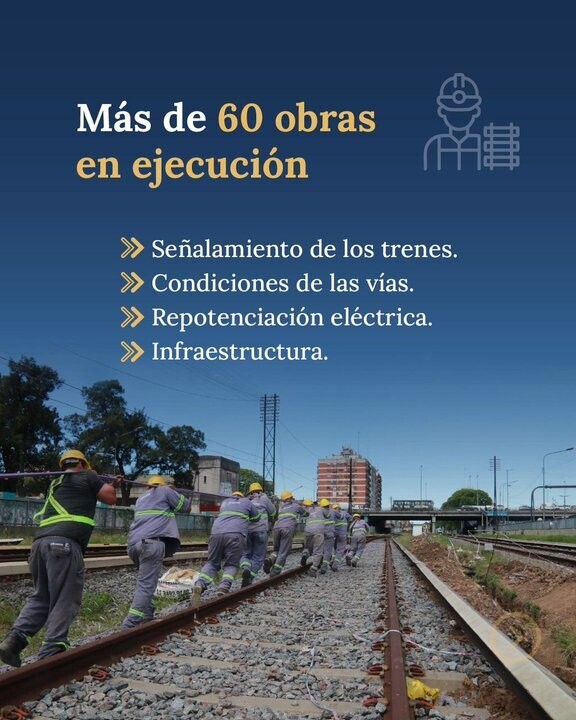
Buenos Aires, December 19 (NA) — Over 60 simultaneous works focused on operational safety and technical efficiency are being carried out in the railway system to reverse its structural deficit. These works are being led by the National Secretariat of Transport, in coordination with Trenes Argentinos, within the framework of the declaration of the Railway Emergency in June 2024, according to official sources informed to the Argentine News Agency. The central objective of this intervention is not only to guarantee daily operation but also to revalue railway assets to facilitate their eventual transfer to the private sector. By recovering basic infrastructure and modernizing the fleet, the National State seeks to deliver a functional, safe, and investment-attractive railway system, ensuring the continuity of public service during the transition. The investment matrix is broken down as follows: 40% - Rolling Stock: Aimed at purchasing new units and repairing the existing fleet after nine years of disinvestment. 36% - Track Infrastructure: Focused on traffic safety and commercial speed. 16% - Signaling: Vital for the frequency and safety of trains. 8% - Various Civil Works: Mitigation of operational risks and critical building repairs. Emphasis has been placed on the modernization of systems that, in some cases, dated back a century. Active Safety: The implementation of the Automatic Train Stop (ATS) system has been achieved on all lines of the Buenos Aires Metropolitan Area (AMBA), installing 11 devices on rolling stock, a fundamental step to prevent collisions. Tracks and Civil Works: More than 30 kilometers of tracks have been renewed on critical routes such as the Mitre and Belgrano Norte lines. Acquisitions and Future Outlook (2026): Within the framework of recovering transport capacity, international acquisitions and key tender processes have been managed (over 100 processes launched via the Official Gazette): San Martín Line: The arrival of three new locomotives is expected for the first quarter of 2026. Electric and Diesel Fleet: An agreement has been closed for the supply of critical spare parts for more than 500 electric cars, and the purchase of 43 triples (totaling 150 cars) has begun to reinforce the AMBA diesel branches. Level Crossing Safety: 62 barrier mechanisms have been renewed and 14 level crossings have been intervened (5 completely renewed and 9 improved), reducing accident rates at urban crossings. The current plan aims to mitigate the consequences of a historic disinvestment that had compromised the safety of the system. Investment Strategy and Resource Allocation: The executed budget reflects a paradigm shift compared to previous administrations, abandoning aesthetic or superficial works (such as the installation of urban furniture in stations) to focus on 'heavy' and structural maintenance. Currently, work is being carried out… 1. Intervention in Critical Infrastructure and Signaling: The action plan prioritizes solving obsolescences that affected the safety and regularity of services. Likewise, the enabling of a new viaduct on the Belgrano Sur line, the renewal of 5 bridges/culverts, and the installation of 12 new track-changing machines are highlighted. Control Systems: Technological modernization includes the laying of 210,000 meters of cabling for signaling, the installation of 53 new signals, the assembly of 6 railway panels, and the comprehensive adaptation of a signaling building. 2.